
Updated September 15, 2026, to add Knoxville’s stadium-area zone and Knox County’s Belltown pilot, per the City of Knoxville’s official DORA Manual 2026. Program rules can change during the pilot; check the current Manual before relying on any detail.
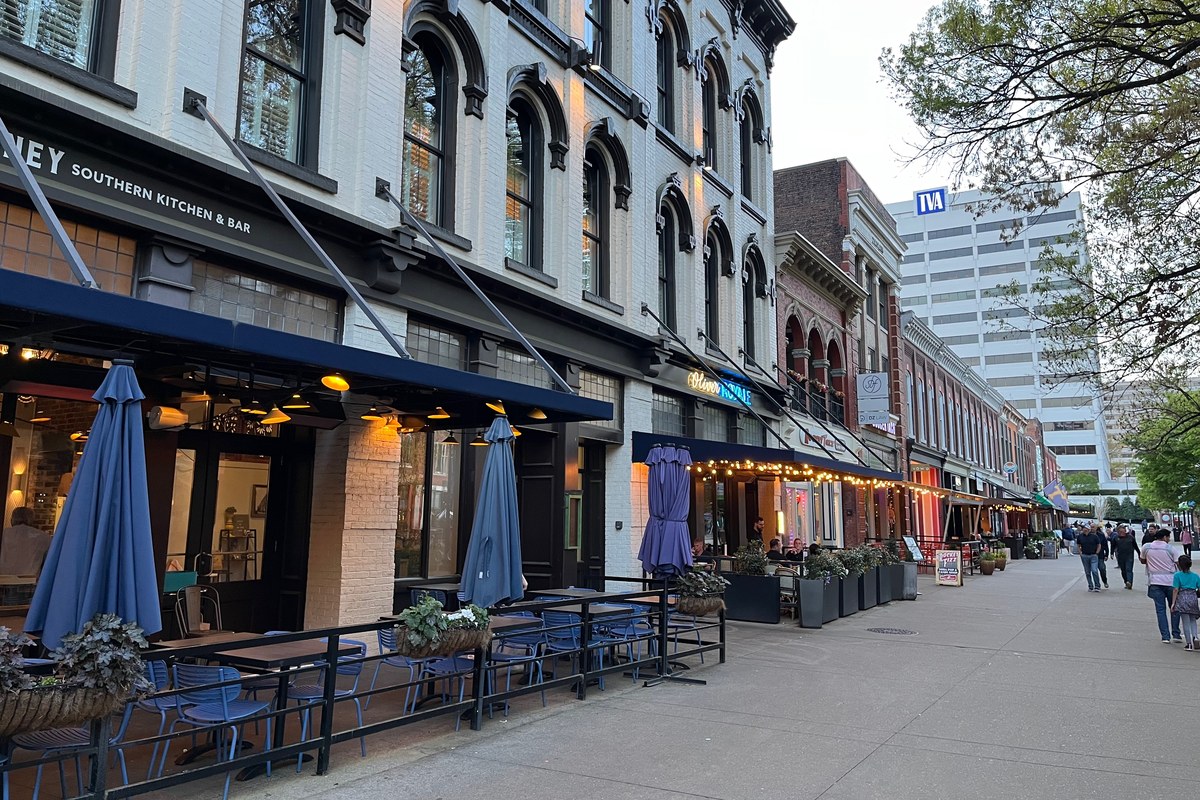
For the first time, Knoxville is allowing drinks purchased from participating businesses to legally travel throughout a designated outdoor area. Market Square’s new Designated Outdoor Refreshment Area, or DORA, officially launched July 24, and a second zone, around Covenant Health Park, is now listed as available in the City’s DORA Manual. Bars and restaurants inside the boundary are working through a new set of questions this year that no amount of licensing experience quite prepared them for.
What launched, and where
The Knoxville City Council approved the Market Square DORA this spring, with the zone bounded by Wall Avenue, Walnut Street, Strong Alley, and Union Avenue. Inside that boundary, during set hours of 10 a.m. to 10 p.m., a guest 21 or older can buy a drink from a participating licensed business and carry it through the public portions of the DORA. The drink has to be in a can or a clear cup with a DORA sticker. The drink may not be carried into another establishment, and it may not leave the zone. Before a guest exits the zone, whatever is left in the cup must be finished or thrown away.
The council followed with an 8-1 vote approving a second DORA around Covenant Health Park and the Old City stadium area, and the City’s DORA Manual now lists it as available. Its boundaries are mapped on the City’s DORA page. The Manual adds one step for this zone: an application must include approval from the stadium’s operator, so start that conversation early.
Knox County has also approved its own version, a 12-month Pedestrian Beverage Zone pilot at the Belltown Commons development in Powell. It is a County program with its own rules, separate from the City’s. What started as one pilot is quickly becoming a pattern.
How this differs from what Tennessee already had
Knoxville is not the first place in Tennessee where alcoholic beverages have been consumed in public under special legal authority. Memphis’s Beale Street has long operated under its own statutory framework and municipal authority, allowing outdoor possession and consumption of alcoholic beverages within the district. And Nashville has periodically authorized outdoor alcohol consumption through special events and other localized measures. Knoxville’s DORA, however, is among the first designated outdoor refreshment areas of its kind in Tennessee. Nashville is also rolling out something new of its own this year. 2026 Public Chapter 1138 created a special-event to-go cup program, but it is a narrower tool than a DORA. It only applies during Metro-approved events inside a temporary event zone, and only for the length of that event. Knoxville’s Market Square DORA runs every day, during set hours: no special event required. That is a meaningfully different commitment for a participating venue: a Nashville business plans around a handful of event weekends, while a Knoxville business inside the DORA is opting into a daily program.
What a participating venue is actually taking on
Businesses must apply and be approved before selling beverages for consumption within the DORA, and participation means more than simply agreeing to sell a to-go drink.
What the application actually requires
Participation requires approval. Applications run through the Special Events Department, they are due annually with a $200 application fee, and a business cannot serve DORA beverages until it is approved. To apply, a business needs a valid current beer and/or TABC license and a current certificate of completion for the Knoxville Alcohol Seller Training (KAST) class. A business that had its beer permit or TABC license suspended or revoked in the previous 12 months is not eligible.
Two details in the approval process require planning in advance. First, approval is tied to the named owner at the named location and does not transfer. If the business closes, relocates, or changes ownership, DORA approval terminates immediately, so a sale or a move means a new application will be required. Second, stickers are not issued by the City. After approval, the City provides the artwork and specifications, and the business orders its own stickers from a vendor of its choice, then notifies the City for a compliance review before serving. A business seeking to participate in the DORA program should calendar lead time for these issues accordingly to avoid delays.
Serving DORA beverages without successfully completing the City’s approval process is not just a DORA violation. It may also expose the establishment to enforcement affecting its underlying beer and liquor license.
The insurance piece most operators have not priced
The DORA application will not be considered without a certificate of insurance attached, and the requirements are specific. A participating business is required to carry several types of coverage, including liquor liability, meeting the City’s required limits and naming the requisite parties as additional insureds. See the City’s DORA Manual.
A business that already holds a patio use agreement should already meet the minimum insurance requirements, which makes this a shorter conversation. All others should speak to their carrier early in the process. The required certificate must be in hand before the application moves, and the business must attest that it will maintain the coverage continuously for as long as it participates in the DORA.
A few things every participating bar or restaurant should have nailed down before opening for a shift inside the zone:
- Every staff member serving inside the DORA must have precise knowledge of where the boundary lines are located. A rough idea is not enough: allowing DORA beverages to leave the designated area creates a compliance issue, and “the map was in the back office” will not suffice as a defense.
- The DORA cup or can requirement will be enforced consistently. A regular pint glass walking out the door because a bartender got busy on a Friday night undercuts the whole program, and undercuts the case for expanding it past the pilot period.
- Serving limits may be narrower than anticipated. A single serving in a DORA container may not exceed 16 fluid ounces, and no single serving may exceed 15% alcohol by volume. Most beer, many wines, and mixed drinks fall within that range, but higher-proof cocktails and higher-ABV wines may not. Service of single shots in a DORA container is prohibited outright.
- Every DORA container must be new. Cups cannot be reused, and the sticker has to be affixed before the beverage is served for removal from the premises. A clear cup with the sticker or a qualifying can are the only options, and no DORA beverage may leave the premises in glass. Businesses are responsible for using approved cups and stickers and for posting the required DORA signage.
- Participation depends on staying in good regulatory standing. DORA approval is suspended for as long as an underlying beer permit or liquor license is suspended, and revoked outright if that license is revoked or if the application contained false statements. A revocation can be reconsidered by written request to the Office of Special Events, and that decision is final.
- ID and age verification still applies. The ability to exit a premises with a labeled cup does not change who may possess and consume the beverage it contains.
- A participating premises must own the 9:30 p.m. last call. The zone runs 10 a.m. to 10 p.m., but last call for DORA beverages is 9:30 p.m. nightly, which means the moment compliant service becomes non-compliant service arrives half an hour before the zone closes. That gap is easy to miss on a busy Saturday, and it needs a member of your team responsible for enforcement rather than an assumption that guests will police themselves.
What it means for your license, not just your sidewalk
A DORA violation is more than simply a customer-service issue. Depending on the circumstances, it can have regulatory consequences for participating businesses and may become part of a broader licensing or enforcement matter if the business fails to comply with the DORA’s operating requirements. A pattern of drinks leaving the zone, or going to the wrong hands, may run through the same TABC enforcement process that already governs everything else your license covers, and violations may become part of a business’s compliance history. Treating a DORA shift with the same seriousness as a normal service shift, rather than as a novelty, is the difference between a program that stays a minor operational adjustment and one that turns into a licensing headache.
There is also a question worth asking before your first DORA shift: does your liquor liability coverage contemplate a drink consumed on a public sidewalk instead of inside your four walls? Most policies were written before this kind of program existed in Tennessee. It is worth a conversation with your carrier.
Why the pilot period is the part that matters most
Knoxville is among the first Tennessee cities to try a DORA. Every business inside the zone is generating the data that decides what happens next. A clean first season makes the case for expanding the program to more zones in Knoxville and to other Tennessee cities weighing their own version. A messy first season, with drinks wandering out of bounds, ID checks slipping, and cups mixed up between businesses, gives critics of the pilot exactly the evidence they need to shut it down or scale it back. Every venue inside the boundary has a stake in the outcome, whether they think about it that way or not.
Where BevLaw Group fits
Whether your business sits inside Knoxville’s DORA today or you are watching to see if something similar lands in your market, the questions are the same: what does your license actually let you do, what do the zone’s rules require your staff to do differently, and what happens if something goes wrong on a night the zone is busy. BevLaw Group works through exactly this kind of question year-round, alongside licensing, contracts, employment guidance, and regulatory defense, on one flat monthly fee you can plan around.
If your business is inside a DORA, or thinking about joining one, walking through what participation actually requires before the first weekend is worth the conversation.